Read entire PDF
Opens in new tab ↗️


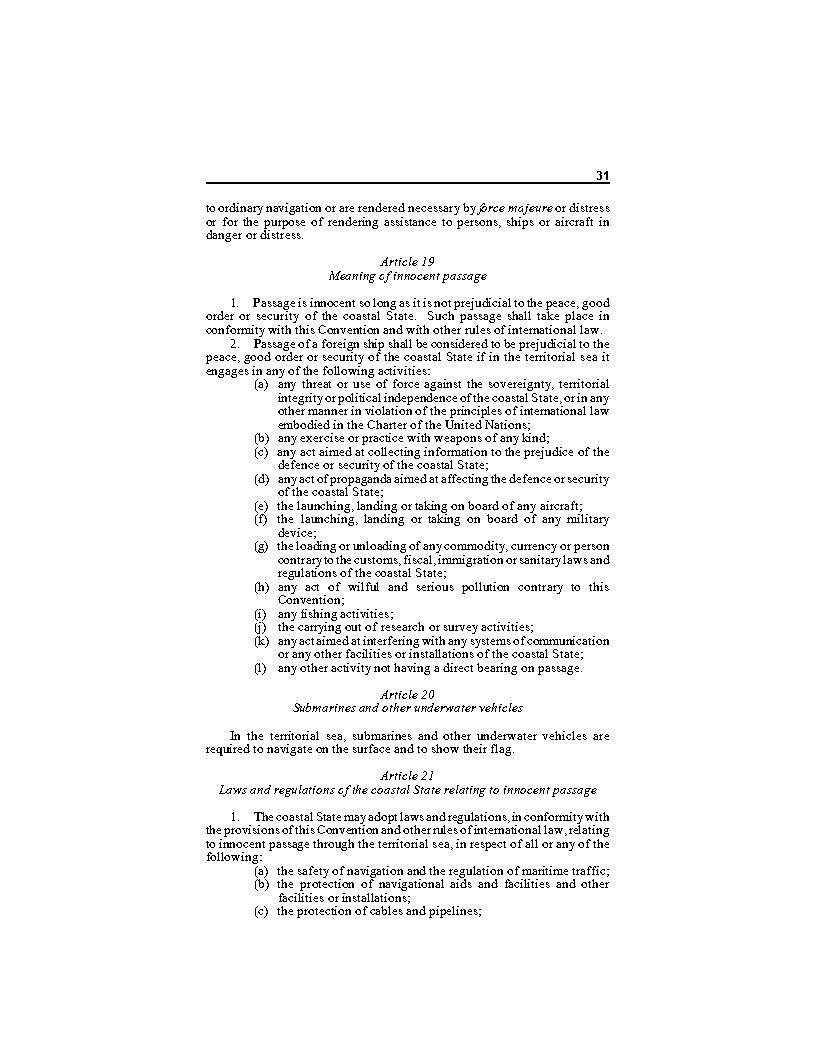
" The coastal State may adopt laws and regulations, in conformity with the provisions of this Convention and other rules of international law, relating to innocent passage through the territorial sea, in respect of all or any of the following: (a) the safety of navigation and the regulation of maritime traffic; (b) the protection of navigational aids and facilities and other facilities or installations; (c) the protection of cables and pipelines; (d) the conservation of the living resources of the sea; (e) the prevention of infringement of the fisheries laws and regulations of the coastal State; (f) the preservation of the environment of the coastal State and the prevention, reduction and control of pollution thereof; (g) marine scientific research and hydrographic surveys; (h) the prevention of infringement of the customs, fiscal, immigration or sanitary laws and regulations of the coastal State."
DEFINITION OF TERMS IN THIS CLAUSE
➡ land beside or near to the sea or ocean
➡ Refers to the various restrictions (measures) that managers can impose to regulate fishing.
➡ Refers to the joint France-Cote d´Ivoire-Senegal fleet that targets tropical tunas off Africa.
➡ harvest of uncultured fish from water bodies.
➡ cold-blooded aquatic vertebrate with gills, no digits, and no limbs other than fins which swims by using its fins and tail.
➡ Navigation which is not prejudicial to the peace, good order or security of the coastal State. i.e. navigation which does not pose any threat or use force against the sovereignty, territorial integrity or political independence of the coastal State, or in any other manner in violation of the principles of international law embodied in the Charter of the United Nations;
➡ Passage means navigation through the territorial sea for the purpose of: a) traversing that sea without entering internal waters or calling at a roadstead or port facility outside internal waters; or (b) proceeding to or from internal waters or a call at such roadstead or port facility.
➡ the salt water that covers most of the earth's surface and surrounds its continents and islands




Please log in or register to access this content. Logging in will grant you acess to subscriber contents like unlimited access to our articles, glossaries, lexicons, quizzes, downloads, forum participation, etc.